I. The Primordial Algorithm of Culture
The sentence sounds like a slogan from a dystopian novel, or perhaps the tagline of a bad science fiction film. Who controls the memes controls the universe. It is usually spoken with a cynical smirk, a nod to the modern internet’s obsession with viral images and fleeting jokes. But if we strip away the irony, we are left with a profound and historically accurate statement about the nature of human civilization.
The term "meme" was not born on Reddit or 4chan. It was coined by the evolutionary biologist Richard Dawkins in his 1976 book, The Selfish Gene. Dawkins proposed the meme as the cultural equivalent of the gene—a unit of cultural transmission that replicates, mutates, and is subject to natural selection. A melody, a catchphrase, a fashion trend, or a religious ritual are all memes. They are the fundamental building blocks of human worldviews.

[Hug Your Loved Ones]
When we talk about war, we are rarely talking about the physical movement of armies or the exchange of gunfire. War is the ultimate expression of a worldview. It is the point at which a society’s foundational beliefs about reality, morality, and the nature of the "other" are pushed to their absolute limits. Before a single bullet is fired, a long process of cultural conditioning must take place. The enemy must be dehumanized. The self must be sanctified. The conflict must be framed as an existential necessity.
This process is not accidental. It is the deliberate curation of memes. The modern landscape of information warfare is not a new phenomenon; it is the acceleration of an ancient human dynamic. The difference is speed, scale, and the architecture of the networks through which these ideas travel.
If we accept that the world is shaped by our perception of it, then the battle to define reality is the only battle that ultimately matters. This is an analysis of how memes shape our understanding of war, how they construct our worldviews, and why the control of these invisible units of culture is the true prize in the global contest for power.
II. The Units of Cultural Inheritance and the Architecture of Belief
To understand how memes relate to war and worldviews, we must first understand how they function. A meme is not merely an image with text on it. It is a compressed packet of meaning. It contains a premise, a value judgment, and an emotional payload. When you look at a popular internet meme, your brain is doing an immense amount of subconscious work to unpack the cultural context required to understand it.
In the realm of cognitive science, this is known as a schema. Our brains build frameworks to understand the world, and memes are the shorthand tools we use to communicate within those frameworks. When a society shares a vast network of overlapping schemas, it possesses a shared worldview.
The philosopher Jean Baudrillard wrote extensively on this in his 1981 treatise, Simulacra and Simulation. He argued that modern society has replaced all reality and meaning with symbols and signs. We no longer experience the real world directly; we experience it through a mediated layer of representation. We live in a world of hyperreality, where the map has become more real than the territory.
A meme is the atomic unit of this hyperreality. It is a piece of the map that masquerades as the territory. When a conflict breaks out—whether a localized skirmish or a global war—the first casualty is objective reality. The second casualty is our ability to perceive it. What replaces reality is a torrent of memes, each competing to define the narrative.
Consider the nature of modern conflict. The images we see of war are not raw footage. They are curated, edited, and captioned. A single image of a destroyed building can be framed in a dozen different ways. It can be a meme of victimhood, a meme of righteous retribution, or a meme of geopolitical inevitability. The image itself does not change, but the meme—the unit of culture attached to it—completely alters the viewer’s perception of the event.
This is why the control of memes is paramount. If you control the memes, you control the schemas. If you control the schemas, you control the worldview. And if you control the worldview, you control how a population will react to war, sacrifice, and death.
III. The Fog of War and the Modern Feed
Throughout history, the justification for war has relied on a foundational reconstruction of the populace's worldview. Before a society can commit to a cataclysmic conflict, the state must reframe the narrative. The war must be transformed from a tragedy of slaughter into a sacred altar of duty.
In the ancient and pre-modern world, this transmission of worldview happened in a direct, personal manner. The king, the priest, or the statesman spoke, and the citizens listened. The narrative was centralized. But in the modern world, the transmission is algorithmic. The dialogue has been replaced by the feed.
Today, the modern citizen is scrolling through a screen. He is bombarded with thousands of memes a day. Each one is a tiny piece of information, a micro-narrative about who is good, who is evil, who is winning, and who is losing. The modern battlefield is not just a geographical location; it is a psychological theater.
The war in Ukraine, the conflict in the Middle East, and the cultural battles within Western democracies are all fought simultaneously on two fronts: the physical and the digital. The physical front determines the immediate outcome of the violence. The digital front determines the historical memory of the violence, the moral justification for it, and the willingness of the population to sustain it.
In this digital theater, the meme acts as a weapon of mass narrative. It bypasses the analytical brain and strikes directly at the emotional center. A complex geopolitical dispute is reduced to a binary choice. Are you with us, or are you with the terrorists? The meme demands immediate allegiance. It leaves no room for nuance, context, or historical ambiguity.
IV. The Mechanics of Moral Transmission
How does a meme successfully alter a worldview? It relies on the mechanics of identity. Human beings are fundamentally tribal creatures. Our survival has historically depended on our ability to belong to a group. We define ourselves not just by who we are, but by who we are against.
Memes are highly effective at signaling group identity. When someone shares a specific meme about a war, they are not just sharing information. They are sending a signal to their peers: I belong to this group. I hold these values. I am on the right side of history.
This is why memes are so dangerous in the context of conflict. They create an in-group and an out-group. They transform complex human beings on the other side of the world into faceless archetypes. The enemy is no longer a father, a son, or a citizen; the enemy is a meme. The enemy is a caricature.
This dehumanization is a prerequisite for modern warfare. It is incredibly difficult for a sane human being to kill another human being. Studies from the military historian S.L.A. Marshall in the 1940s suggested that only a small percentage of soldiers actually fired their weapons in combat during World War II. The military recognized this problem and implemented training that relied heavily on conditioning—which is, in essence, the internalization of a violent meme.
Today, this conditioning happens on a global scale. The memes we see online prepare us emotionally for the violence that our governments and institutions perpetrate. By framing the conflict as a battle between absolute good and absolute evil, the meme absolves the viewer of moral complexity. It makes the war seem necessary, just, and inevitable.
The French philosopher René Girard developed a theory of mimetic desire, arguing that human beings desire things because they see others desiring them. This creates rivalry, which leads to conflict and violence. In the modern age, this mimetic cycle is accelerated by digital networks. We see the memes that our enemies share, and we define ourselves in opposition to them. The war becomes a self-fulfilling prophecy of competing mimetic desires, where each side believes they are fighting for survival against an existential threat.
V. The Illusion of the Organic Spread
The central premise of the statement Who controls the memes controls the universe is the assumption that memes can be controlled. But do we actually control them? Or do we merely believe we do?
In the early days of the internet, there was a utopian belief that the network was a decentralized, democratic space. Information would flow freely, and the best ideas would rise to the top. The reality has proven to be far more complex.
While the internet is vast, the mechanisms of distribution are not neutral. They are governed by algorithms. These algorithms are designed by corporations whose primary goal is not the pursuit of truth, but the maximization of engagement. They want you to stay on the screen. They want you to click, to like, to share, and to argue.
The algorithm does not care about the moral quality of a meme. It cares about its viral potential. Highly emotional content—outrage, fear, anger—is the most viral. Therefore, the algorithms amplify the most extreme and divisive memes. They create a feedback loop where the most polarizing worldviews are pushed to the forefront of our collective consciousness.
 [Outrage - Nuance and Reality]
This has led to the fracturing of the shared worldview. We no longer have a central narrative. We have thousands of micro-narratives. We have echo chambers. We have people living in completely different realities, consuming completely different memes.
When a crisis occurs, the state cannot simply issue a decree and expect the population to comply. The state must compete with a million independent content creators, journalists, pundits, and anonymous trolls. The control of the meme is not held by a single cabal or a secret shadow government. It is a chaotic, emergent property of the network itself.
However, this does not mean that control is impossible. State actors have learned to navigate this environment. They understand that in a world of information overload, the most effective way to control the narrative is to flood the zone with noise. By creating confusion, doubt, and apathy, they can paralyze the public’s ability to form a coherent worldview.
This strategy is known as reflexive control, a concept developed by Soviet military theorists. The idea is to influence the enemy’s decision-making process by feeding them information that leads them to make conclusions that favor your side. In the digital age, this is executed through bot farms, targeted advertising, and the strategic deployment of memes.
VI. The War on the Cognitive Frontier
The battle for the control of memes is not a distant geopolitical game. It is happening in the cognitive frontier of every individual’s mind.
Every time you open a social media app, you are entering a battlefield. The memes that appear on your feed are not there by accident. They are there because an algorithm has determined that they will engage you. They are tailored to your biases, your fears, and your desires.
This is a form of cognitive warfare. It is a war fought not with bullets, but with narratives. The goal is to occupy the territory of your mind. If an adversary can plant a sufficiently powerful meme in your consciousness, they can influence your behavior without you ever realizing it.
Consider the modern political landscape. Elections are no longer won on the strength of policies or the integrity of candidates. They are won on the strength of the memes they generate. A single viral image can destroy a political career. A single piece of misinformation can sway the outcome of a democratic process.
The great irony of the modern age is that we have more access to information than at any point in human history, yet we are arguably less informed. The sheer volume of data has overwhelmed our cognitive capacity. We rely on memes as heuristics—mental shortcuts to navigate a complex world. But these shortcuts are often weaponized. They are designed to bypass critical thinking and trigger an immediate emotional response.
The philosopher Marshall McLuhan famously stated, "The medium is the message." In the era of the meme, this has never been more true. The format of the meme—brief, visual, emotionally charged, lacking context—shapes the way we perceive reality. It fragments our attention. It dissolves nuance. It creates a world of absolute certainties and eternal conflicts.
VII. The Architecture of Consent
Edward Bernays, the father of public relations, wrote in his 1928 book Propaganda that the conscious and intelligent manipulation of the organized habits and opinions of the masses is an important element in a democratic society. He argued that those who manipulate this unseen mechanism of society constitute an invisible government which is the true ruling power of our country.
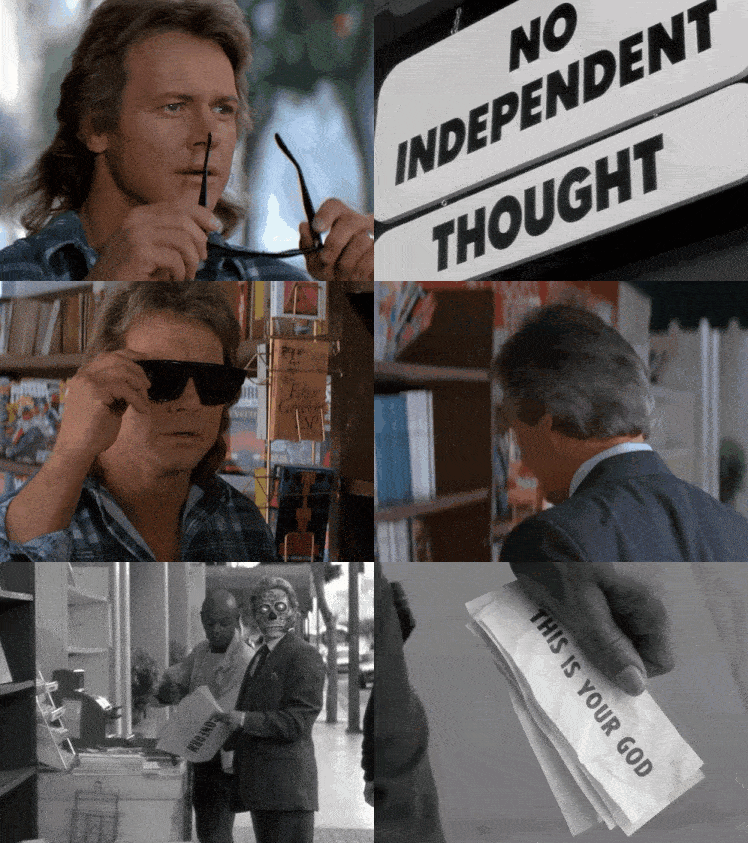
[Invisible Government]
In the twentieth century, this invisible government operated through newspapers, radio, and television. It was centralized and top-down. The state and the corporate elite controlled the memes. They controlled the public's worldview through mass media.
In the twenty-first century, the architecture of consent has become decentralized. The invisible government is no longer a single entity. It is a complex network of algorithms, influencers, corporations, and state actors. The memes are not handed down from a central authority; they are generated by the collective, amplified by the algorithm, and weaponized by anyone with an agenda.
This decentralization has profound implications for the nature of war and peace. In a centralized media environment, it is possible for a government to make a peace treaty acceptable to the public by controlling the narrative. In a decentralized environment, the public is constantly bombarded with contradictory narratives. The idea of a unified national purpose becomes impossible to sustain.
We see this clearly in the modern response to global conflicts. Any attempt to establish a factual baseline of events is immediately met with a barrage of memes claiming that the baseline is a lie. The consequence is a deep, pervasive cynicism. When people no longer know what is true, they stop believing in anything. They retreat into their own echo chambers, where they feel safe from the cognitive dissonance of the outside world.
VIII. The Sovereign Individual in the Age of the Feed
If the control of memes controls the universe, what is the responsibility of the individual? How does one navigate a world where reality is constantly being hacked?
The first step is awareness. You must recognize the environment you are in. You must understand that the internet is not a neutral public square; it is a highly engineered environment designed to capture your attention and shape your worldview.
The second step is cognitive sovereignty. You must reclaim your mind from the feed. This means limiting your exposure to algorithmic content. It means seeking out primary sources. It means reading long-form journalism and books. It means engaging in conversations that require patience and nuance.
The third step is the cultivation of a resilient worldview. This is the modern equivalent of Stoic philosophy. The Stoics understood that we cannot control the chaotic battlefield of the world, but we can control our own minds and our reactions to it. It means remaining steadfast in the face of the chaos of the battlefield, grounding your identity in something deeper than the fleeting memes of the day.
In the modern context, this means finding meaning in your family, your community, your work, and your spiritual practice. It means resisting the temptation to be defined by the latest outrage or the latest political trend.
The war for the control of memes is ultimately a war for the control of the human soul. The side that wins will be the side that can make its version of reality seem inevitable. But the individual always retains the choice. You can choose to be a passive consumer of the feed, or you can choose to be a conscious participant in reality.
IX. The Inevitability of the Metaphor
We must return to the central metaphor. Who controls the memes controls the universe. It is a statement that sounds absolute, yet it describes a chaotic and fragmented reality.
No one truly controls the memes. The universe is a complex adaptive system. It is too vast, too decentralized, too messy for any single entity to dominate. The best that any state, corporation, or individual can do is influence the flow. They can plant seeds, amplify certain signals, and attempt to suppress others. But they cannot control the ultimate outcome.
However, the illusion of control is powerful. Those who believe they control the memes often act with a certainty that is dangerous. They believe they are shaping the world according to their own design. They believe they are the architects of reality.
This is the ultimate hubris. The universe is not a machine that can be programmed. It is a living, breathing organism. The memes are not just tools; they are the vital impulses of the organism. They are the collective dreams, fears, and desires of humanity.
To try to control them is to try to control the tide. You can build walls, you can dig channels, but eventually, the water will find a way through. The only rational response is to learn how to swim.
The analysis of war and worldviews through the lens of memes is not a call to despair. It is a call to clarity. It is an invitation to look past the curated images and the catchy slogans. It is an invitation to see the world as it truly is, in all its terrifying, chaotic, and beautiful complexity.
X. The Return to the Real
The ultimate counter to the weaponization of memes is the return to the real. The real is that which cannot be reduced to a caption or a joke. The real is the pain of a mother losing her child in a conflict she does not understand. The real is the quiet dignity of a community rebuilding after a disaster.
Memes have a tendency to abstract. They turn the human experience into a punchline. They turn the tragedy of war into a spectacle. They turn the complex web of human relationships into a binary of us versus them.
We must resist this abstraction. We must insist on the primacy of the concrete. When we see a meme about a war, we must ask: what is the actual human reality behind this image? Who is suffering? Who is dying? Who is profiting?
The war for the control of memes is a war for the control of meaning. The only way to win is to refuse to play by their rules. We must build our own meaning. We must define our own reality. We must create memes of compassion, understanding, and nuance.
It is a difficult task. It is a lonely task. It is a task that will likely fail in the grand scheme of the universe. But it is the only task worth undertaking.
Because if we allow the control of memes to dictate our worldview, we lose the one thing that makes us human: the ability to think for ourselves. We lose the ability to see the truth. We become merely vessels for the narratives of others.
And in the end, that is the ultimate victory of the enemy. Not the conquest of territory, but the conquest of the mind.
The universe is vast. It is infinite. It is older than time and it will outlast us all. The memes will fade. The wars will end. The worldviews will collapse. But the human capacity for truth, for love, and for understanding will remain.
We must not let the chaos of the digital age obscure this fundamental reality. We must hold fast to the eternal truths that exist beyond the reach of the algorithm. We must remember that we are not merely consumers of information. We are creators of meaning.
The battle is fierce. The noise is deafening. But we have the power to silence the noise. We have the power to look past the meme. We have the power to see the world as it is, and to choose to make it better.
The control of the universe is not held by those who control the memes. It is held by those who control their own minds.
Sources
- Dawkins, Richard. The Selfish Gene. Oxford University Press, 1976.
- Baudrillard, Jean. Simulacra and Simulation. Editions Galilée, 1981.
- Girard, René. Things Hidden Since the Foundation of the World. Stanford University Press, 1987.
- Bernays, Edward. Propaganda. Horace Liveright, 1928.
- McLuhan, Marshall. Understanding Media: The Extensions of Man. McGraw-Hill, 1964.
- Marshall, S.L.A. Men Against Fire: The Problem of Battle Command. William Morrow & Company, 1947.
- Postman, Neil. Amusing Ourselves to Death: Public Discourse in the Age of Show Business. Viking Penguin, 1985.
- Han, Byung-Chul. The Burnout Society. Stanford University Press, 2015.